



Get In Touch With Us
Connect with Metals-Tech
Ready to take the first step towards unlocking opportunity realizing goals, and embracing innovation?
-
 CALL ANY TIME
 -
 Follow Us
LinkedIn
-
 Say Hello
info@metals-tech.com
Integrating System Intelligence and Model Intelligence
The next architecture of industrial automation: from L0–L3 hierarchical control to a dual-layer System-and-Model Intelligence framework.
Industrial automation is entering a new era.
For decades, automation has followed a clear, layered structure:
- L0: Sensors, drives, actuators, and instruments
- L1: Real-time control (PLC, AGC, AFC, sequence control)
- L2: Process models (rolling schedules, thermal models, setup calculations)
- L3: Production planning and plant management
This L0–L3 architecture has served industry extremely well. It is reliable, deterministic, and highly engineered. And it will remain essential.
But the next generation requires more: the ability to understand, reason, learn, and evolve—not just execute.
The future is not simply “adding AI on top.”
It is rethinking the architecture itself.
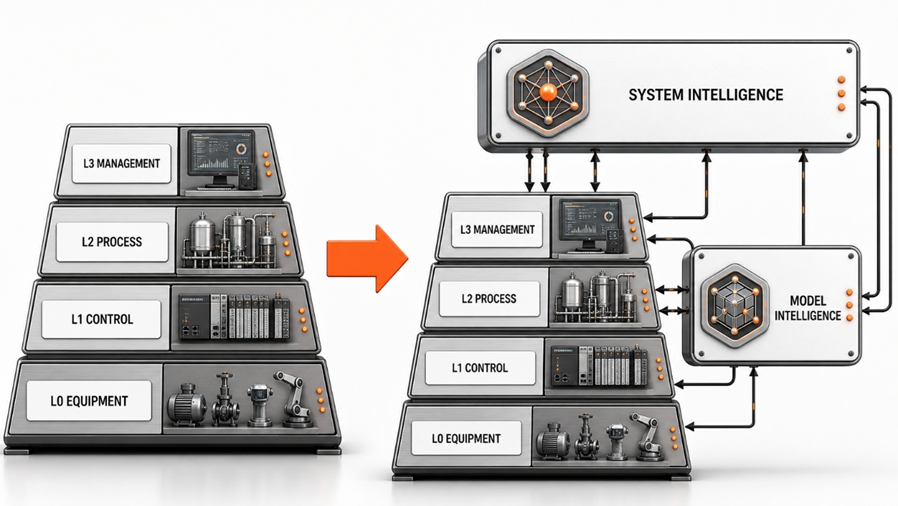
Metals-Tech envisions a new AI-native industrial automation built on two complementary forms of intelligence:
- System Intelligence – The global brain
- Model Intelligence – The continuously evolving expert
Together, they form a new control architecture that gradually transforms automation from predefined execution toward adaptive, predictive, and autonomous operation.
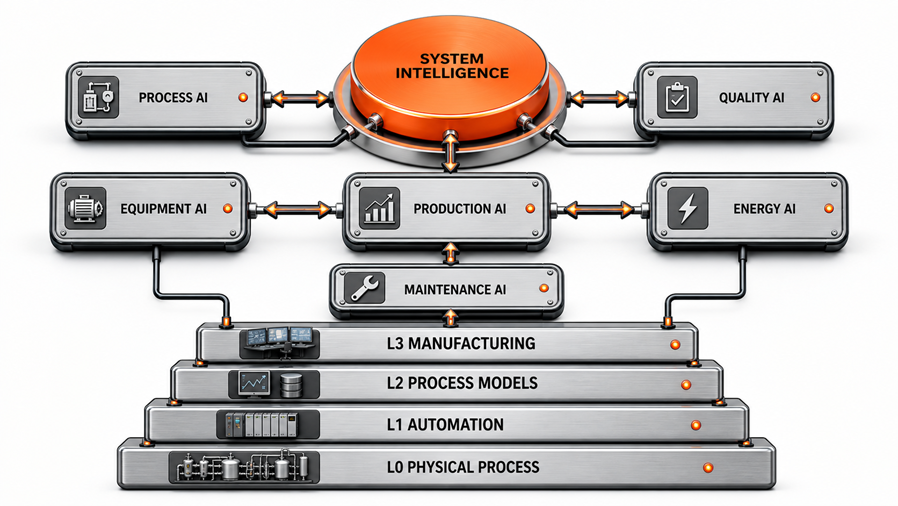
System Intelligence: Understanding the plant as a whole
Rather than focusing on one control loop or process model, System Intelligence continuously observes the complete production environment:
- Equipment condition
- Production schedule and material status
- Process stability and product quality
- Energy consumption, alarms, maintenance needs
- Operator actions and historical performance
Traditional automation asks: “What should this controller do now?”
System Intelligence asks: “What should the entire production system do next?”
This is the transition from local control to global coordination, from alarm response to situation understanding, from operator-dependent decision making to AI-assisted industrial reasoning.
Model Intelligence: Continuously evolving process knowledge
Industrial production has always depended on models:
- Rolling force, forward slip, thermal, material deformation
- Flatness, crown, cooling, coiling, tension
- Furnace, mechanical property, energy, equipment degradation
Traditionally, these models were static—built from physics, tuned during commissioning, and then fixed.
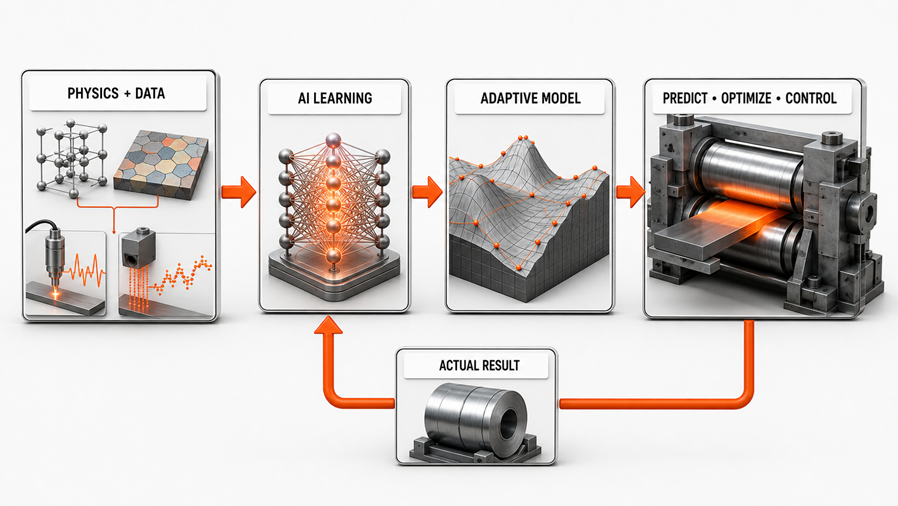
AI changes this. The model can now continuously compare prediction vs. reality and improve itself.
Physics First, AI Enhanced
Pure black-box AI is not enough for industrial control. The most powerful architecture combines:
Physical Model + Metallurgical Knowledge + Historical Data + Real-Time Data + Machine Learning + Adaptive Optimization
AI doesn’t replace physics. It enhances it.
Physics provides structure. AI provides adaptation.
From fixed models to self-evolving models
Production never stops changing: raw materials, product mix, roll condition, equipment age, lubrication, ambient conditions, new products. A static model gradually becomes less representative. Model Intelligence turns the model into a living component of the automation system—continuously evaluating its own predictions, learning, and adapting.
System Intelligence: Coordinating the whole plant
Consider a hot rolling mill. A traditional system independently controls furnace, descaling, roughing, finishing, cooling, coiling, tracking.
An AI-native system understands the relationships among them.
Abnormal slab temperature → higher rolling force → gauge deviation → finishing temperature change → mechanical property shift → coiling adjustment → quality attention required.
Traditional automation sees several signals. System Intelligence sees one production event.
That distinction is fundamental.
The AI-Native Control Loop
Traditional control: Target → Execute → Measure → Correct
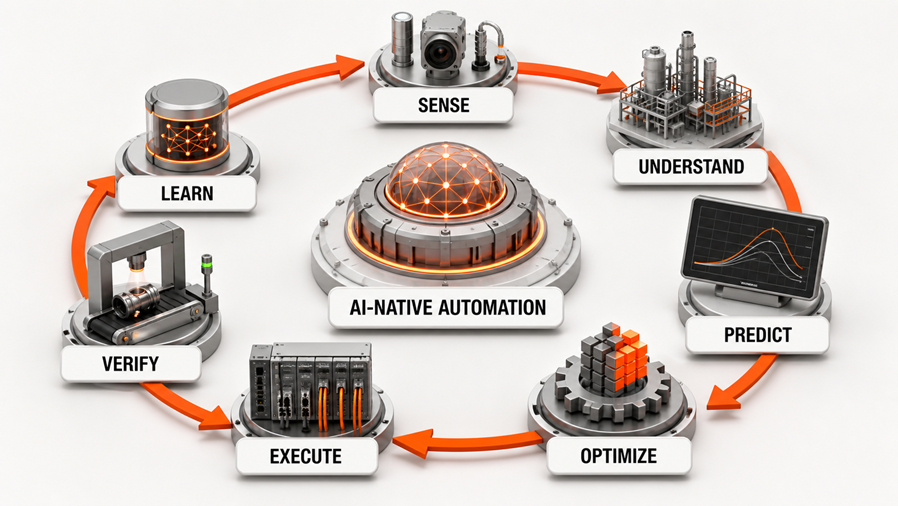
AI-native automation adds a cognitive cycle:
Observe → Understand → Predict → Optimize → Execute → Verify → Learn This creates a continuous loop of perception, reasoning, optimization, and learning.
What happens to Level 0–Level 3?
They remain.
Deterministic automation must stay deterministic: emergency stops, protection logic, high-speed drive control, millisecond-level hydraulic control, safety interlocks.
AI provides a higher level of perception, prediction, optimization, and coordination.
The result is a hybrid architecture:
| Deterministic Layer | Intelligent Layer |
| Safety, real-time control, sequence execution, motion control, technological regulation | Understanding, prediction, optimization, learning, reasoning, decision support |
Industrial reliability + intelligent adaptability.
Digital Twin becomes the plant’s world model
In AI-native automation, the Digital Twin becomes more than visualization—it becomes the contextual brain of the system:
- What equipment exists and how it is connected
- What material is being processed and where
- What process conditions exist
- What constraints and production targets apply
The plant changes from a collection of data tags into an understandable industrial environment.
Data becomes industrial memory
Data alone is not intelligence. The AI-native plant transforms data into structured memory.
Every coil, slab, and product can contribute to the plant’s knowledge:
- Which setup produced the best quality?
- Which conditions preceded a defect?
- Which parameter combination created instability?
- Which strategy minimized energy?
Data becomes Memory.
Models become Knowledge.
AI becomes Reasoning.
Automation becomes Action.
The human role will also change
AI-native automation does not remove industrial experts. It changes how their expertise is used.
The operator evolves from Machine Operator → Production Supervisor → Industrial Intelligence Supervisor.
AI becomes an engineering partner—not a replacement, but an amplifier of human knowledge.
From automation to autonomy
The long-term journey toward the Autonomous Plant can be understood in five stages:
- Automated – Machines execute predefined logic
- Connected – Data becomes visible across systems
- Predictive – Models anticipate quality and process behavior
- Adaptive – The system optimizes in changing conditions
- Autonomous – The plant continuously optimizes with limited human intervention
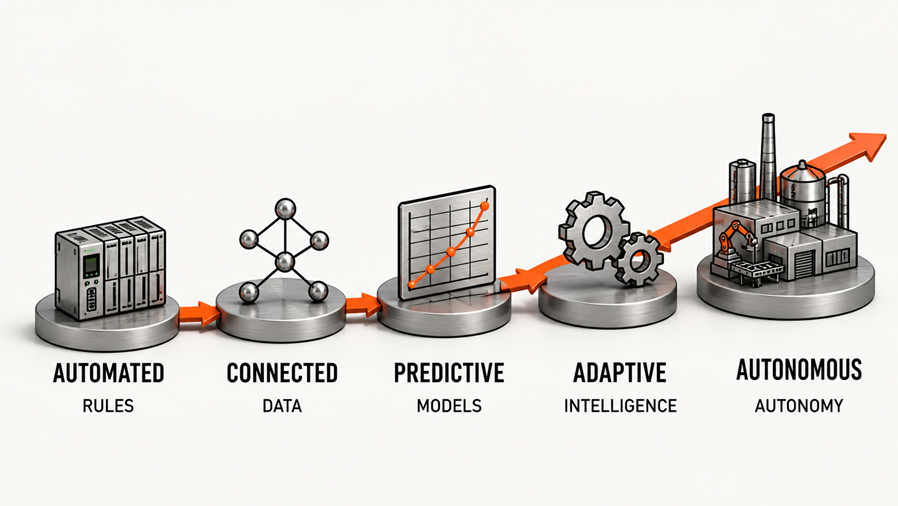
It is Automatic → Intelligent → Autonomous.
Why metals production is a natural fit
Metals manufacturing is:
- Continuous and dynamic
- Highly coupled and energy intensive
- Metallurgically complex and quality critical
Small upstream deviations create large downstream consequences. This is precisely where System Intelligence and Model Intelligence create value.
The Metals-Tech vision
AI changes the technology, but process is still the core.
The value of industrial AI will be measured by production results: better gauge, flatness, surface, mechanical properties; higher yield, throughput; lower energy, downtime; faster product development, more stable production.
AI without process knowledge is only an algorithm.
Process knowledge without learning remains static.
The combination creates industrial intelligence.
Conclusion: Beyond L0–L3
The L0–L3 architecture will remain the deterministic foundation. But the architecture of intelligence is changing.
The next generation of automation will be defined by how the entire production system understands, predicts, optimizes, and learns.
This is:
System Intelligence + Model Intelligence
built upon L0–L3
leading toward Autonomous Production.
Not AI added to automation.
Automation designed for AI from the beginning.
Not isolated intelligent functions.
A continuously learning production system.
Not simply a smarter controller.
A smarter plant.
This is the future of AI-native industrial automation—and it is already beginning.


