



Get In Touch With Us
Connect with Metals-Tech
Ready to take the first step towards unlocking opportunity realizing goals, and embracing innovation?
-
 CALL ANY TIME
 -
 Follow Us
LinkedIn
-
 Say Hello
info@metals-tech.com
Full-line automation and process intelligence for high-performance materials in demanding industries

In today’s stainless steel industry, capacity is no longer the most important question.
Large-scale production lines, impressive annual output figures and broad product catalogues are no longer enough to define competitiveness. As the market becomes more price-sensitive and conventional stainless steel products face increasing pressure, the real value of a modern plate production line lies in a different question:
Can it manufacture difficult materials, in flexible batches, with stable quality and fast delivery?
This question is especially important for high-end stainless steel and special alloy plate products, including duplex stainless steel, super duplex stainless steel, super austenitic stainless steel, nickel-based corrosion-resistant alloys, high-temperature alloys and precipitation-hardening stainless steels.
These materials are not ordinary commodities. They are used in chemical equipment, energy systems, marine engineering, pressure vessels, heat-resistant components, high-end manufacturing equipment and critical industrial applications. Customers do not only buy steel plate. They buy reliability, delivery certainty, process confidence and long-term material performance.
Metals-Tech provides full-line Electrics, Automation and Digital solutions for advanced plate production lines, helping producers transform complex special alloy manufacturing into a stable, traceable and high-value industrial capability.
The Market Is Changing: From Volume Production to Specialized Manufacturing
China does not lack stainless steel capacity. It does not lack production scale. What the market increasingly needs is the ability to respond to complex orders.
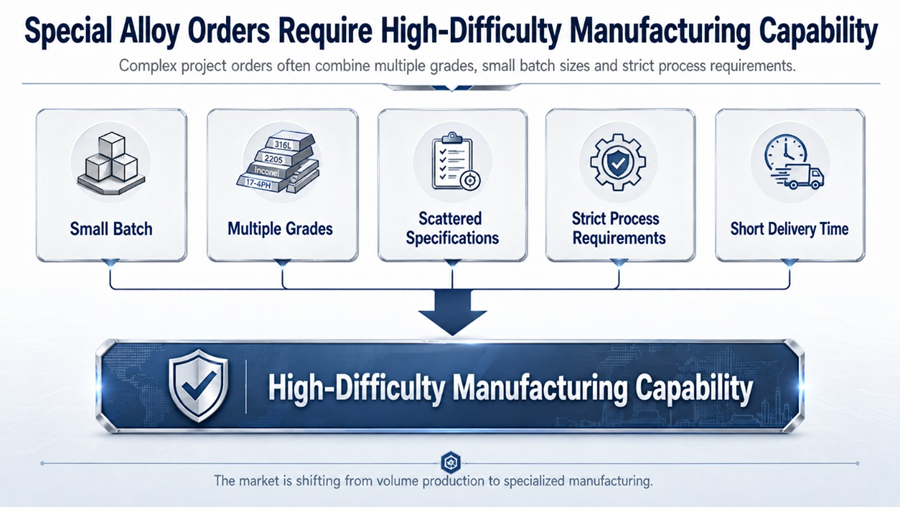
Special alloy plate orders are often very different from conventional mass-production orders. A chemical project may require 2205 duplex stainless steel, 2507 super duplex stainless steel and nickel-based alloy plates at the same time. The order volume may be limited, the specifications may be scattered, and the technical requirements may include special heat treatment, ultrasonic testing, surface inspection, tight dimensional tolerance and strict delivery schedules.
For large-scale production systems, such orders are difficult to organize. Mills prefer continuous production: one grade, one process route, one large batch and long rolling campaigns. But special alloy customers often require the opposite:
This is why the high-end plate market requires a new type of production capability: not only strong equipment, but also strong process organization, process control and digital quality management.
High-End Stainless Steel and Superalloy Plate: Why It Is Difficult
The term “high-end material” is often used too easily. In real manufacturing, these materials are difficult not because they sound premium, but because their process windows are narrow and their quality risks appear early.
For conventional stainless steel, stable production is already important. For high-alloy materials, it becomes critical.
The final plate quality is affected by many upstream and downstream factors:
| Process Factor | Influence on Final Plate Quality |
| Chemical composition control | Determines corrosion resistance, strength and phase balance |
| Inclusion and cleanliness control | Affects UT result, fatigue behavior and reliability |
| Solidification condition | Influences segregation, internal defects and hot workability |
| Reheating schedule | Determines temperature uniformity and deformation readiness |
| Rolling pass schedule | Affects grain structure, plate shape and dimensional accuracy |
| Temperature window | Critical for duplex steel, nickel alloys and high-temperature alloys |
| Heat treatment | Determines final microstructure and mechanical properties |
| Cooling control | Influences phase transformation and property stability |
| Surface treatment and pickling | Determines surface quality and downstream usability |
| Inspection and traceability | Provides quality evidence for critical applications |
Materials such as 2507, alloy 625, C276 or 800H cannot be understood simply as steel with more nickel, chromium or molybdenum. Each grade has its own hot workability, precipitation sensitivity, solution annealing requirement, cooling requirement and quality risk.
If the process window is missed, later finishing cannot fully recover the internal quality.
Full-Process Manufacturing: The Real Foundation of Special Alloy Plate
For high-performance plate production, each process section must be connected into one coherent system. Rolling, heat treatment, pickling, straightening, inspection and finishing cannot operate as isolated islands.
A modern special alloy plate line needs integrated control across the complete route.
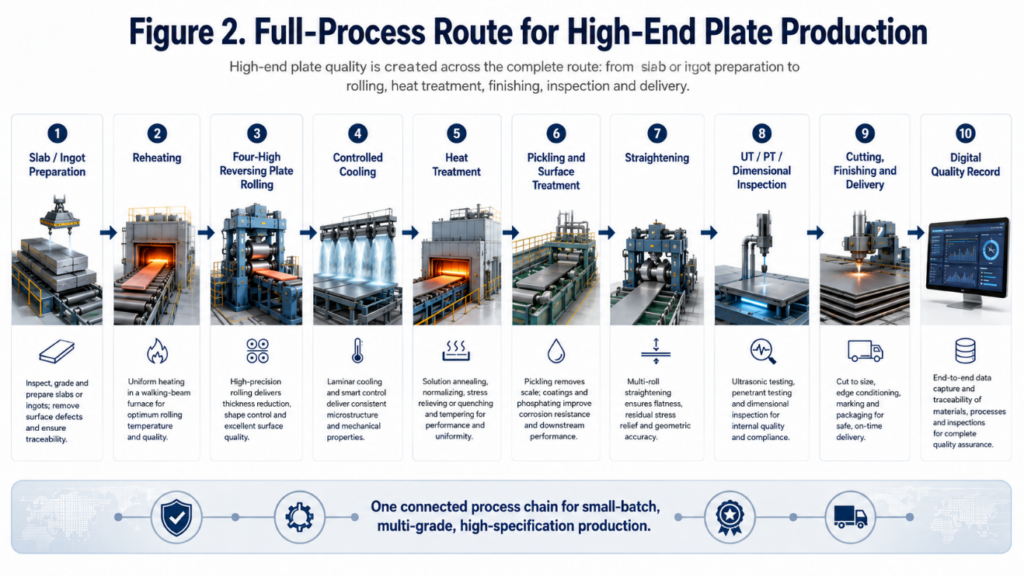
This complete process chain is especially important for small-batch, multi-grade and high-specification orders. The producer must know not only whether a plate is qualified, but also how that quality was created.
Four-High Reversing Plate Mill: Flexibility for Complex Materials
For high-end stainless steel and special alloy plate, a four-high reversing plate mill provides important manufacturing flexibility. It allows the production of different grades, thicknesses and widths with controlled pass schedules and process adaptation.
However, the rolling mill itself is only part of the answer. To produce difficult materials consistently, the automation system must coordinate rolling force, screwdown, roll gap, plate temperature, pass reduction, speed, descaling, plate tracking and operator guidance.
Metals-Tech’s automation solutions support:
| Control Area | Technical Value |
| Pass schedule control | Stable deformation path for different grades and thicknesses |
| Rolling force and gap control | Improved thickness accuracy and plate geometry |
| Temperature tracking | Better control of hot-working window |
| Speed and drive coordination | Stable rolling process and reduced disturbance |
| Plate tracking | Accurate material identity throughout the line |
| Operator guidance | More consistent execution of complex rolling procedures |
| Data collection | Foundation for process analysis and quality improvement |
For high-temperature alloys and nickel-based alloys, rolling stability is not only a productivity issue. It is directly related to internal quality and final material performance.
Heat Treatment: Where Material Performance Is Finalized
Heat treatment is one of the most critical steps in high-end stainless steel and superalloy plate production. For many special alloys, rolling creates the geometry, but heat treatment defines the final performance.
Duplex stainless steels require proper phase balance. Super austenitic stainless steels require corrosion resistance and structural stability. Nickel-based alloys require controlled solution treatment and stable microstructure. Precipitation-hardening stainless steels require precise heat treatment to achieve target strength and performance.
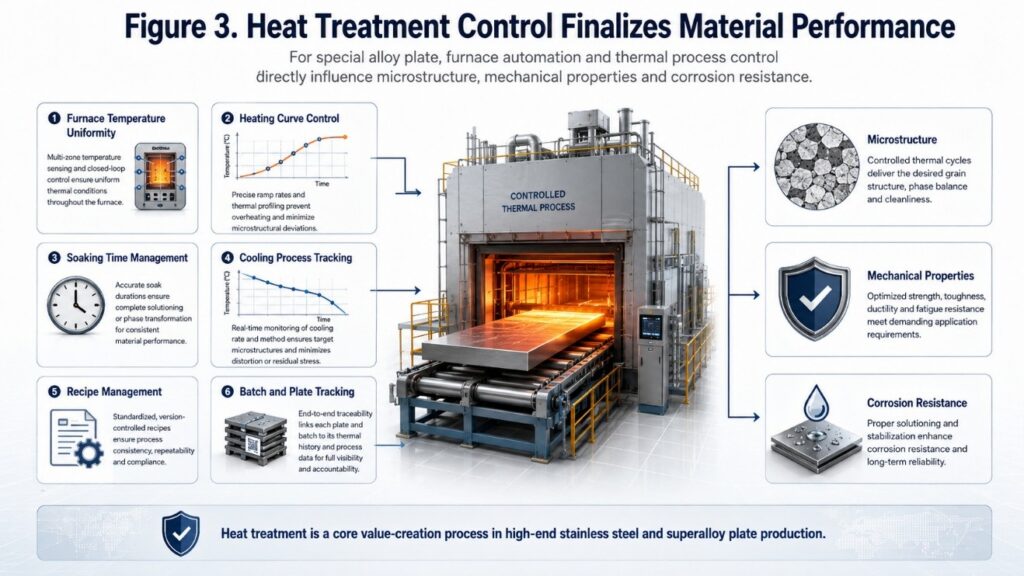
Metals-Tech’s furnace automation and process control functions help manage:
| Heat Treatment Control | Quality Contribution |
| Furnace temperature uniformity | Reduces property variation across plate length and width |
| Heating curve control | Ensures correct thermal history for each grade |
| Soaking time management | Supports uniform microstructure |
| Cooling process tracking | Improves repeatability of final properties |
| Recipe management | Reduces manual error for multi-grade production |
| Batch and plate tracking | Links heat treatment data with final inspection result |
In high-end material production, heat treatment is not a secondary process. It is a core value-creation process.
Inspection and Traceability: From Qualification to Customer Confidence
For special alloy plate, qualification is not only about passing inspection. It is about proving the full manufacturing history.
Customers in demanding industries often require ultrasonic testing, penetrant testing, dimensional inspection, surface inspection, mechanical testing, corrosion-related testing and full material certification. A modern production line must connect these results with process data.
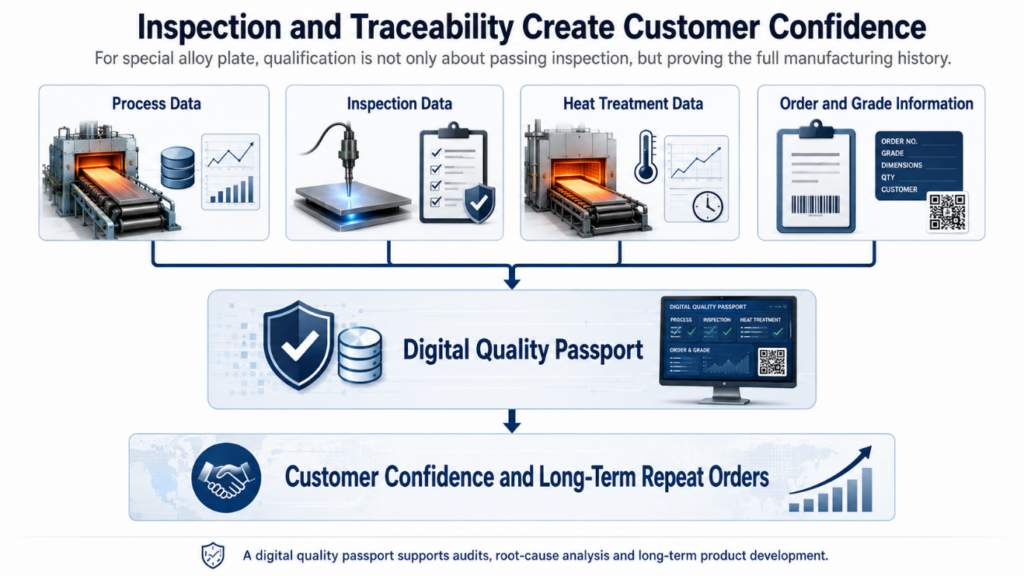
Metals-Tech’s digital quality management system enables coil- or plate-based process genealogy, including:
| Data Category | Typical Information |
| Material identity | Heat number, grade, specification and order route |
| Rolling history | Pass schedule, force, gap, speed and temperature |
| Heat treatment history | Furnace number, recipe, temperature curve and time |
| Surface treatment | Pickling, finishing and surface quality data |
| Inspection results | UT, PT, dimensional inspection and final judgment |
| Delivery record | Plate identity, certificate data and customer requirement |
This digital quality passport is essential for high-value customers. It supports root-cause analysis, customer audits, process improvement and long-term product development.
From “Can Produce” to “Can Produce Stably”
In the special alloy industry, there is a major difference between producing one qualified batch and producing stable quality over many years.
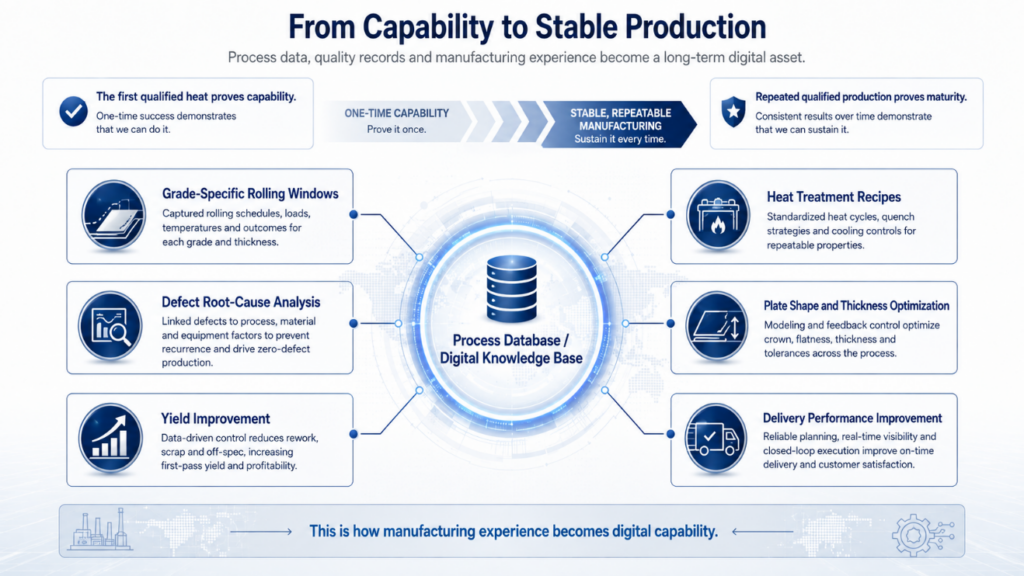
The first qualified heat proves capability.
Repeated qualified production proves maturity.
A producer may successfully manufacture a difficult grade once or twice. The real test begins when the same grade must be produced repeatedly under changing conditions: different customers, different thicknesses, different widths, different heat numbers, different delivery times and different technical requirements.
At that stage, the process database becomes one of the most valuable assets of the enterprise.
Metals-Tech helps producers build this asset by connecting automation systems with process data, quality data and production records. Over time, this creates a knowledge base for:
- Grade-specific rolling windows
- Heat treatment recipes
- Defect root-cause analysis
- Plate shape and thickness control optimization
- Yield improvement
- Delivery performance improvement
- Customer-specific technical requirements
- Continuous process learning
This is how manufacturing experience becomes digital capability.
The Value of Flexible Special Alloy Production
High-end stainless steel and superalloy plate production is not only about making the most difficult grade. It is about responding to real customer needs.
Many customers do not require the largest volume. They require the right plate, in the right specification, with the right certificate, at the right time.
For chemical equipment manufacturers, energy projects, marine engineering companies or high-end machinery builders, the value of fast and reliable delivery can be greater than a small material price difference. A delayed plate may delay an entire project.
This creates strong value for producers who can combine:
| Capability | Customer Value |
| Multi-grade production | One-stop supply for complex projects |
| Small-batch flexibility | Better response to scattered demand |
| Fast delivery | Reduced customer project delay risk |
| Process stability | Lower quality uncertainty |
| Full inspection | Higher confidence in critical applications |
| Technical support | Faster solution when specifications change |
| Digital traceability | Stronger evidence for audits and certification |
In high-end material markets, the customer is not simply buying tonnage. The customer is buying manufacturing reliability.
Metals-Tech’s Role in High-End Plate Automation
Metals-Tech provides full-line automation and digital solutions for advanced plate production. Our capabilities cover Level 0 instrumentation, Level 1 basic automation, drive systems, Level 2 process models, HMI/SCADA, data systems, production tracking and quality management.
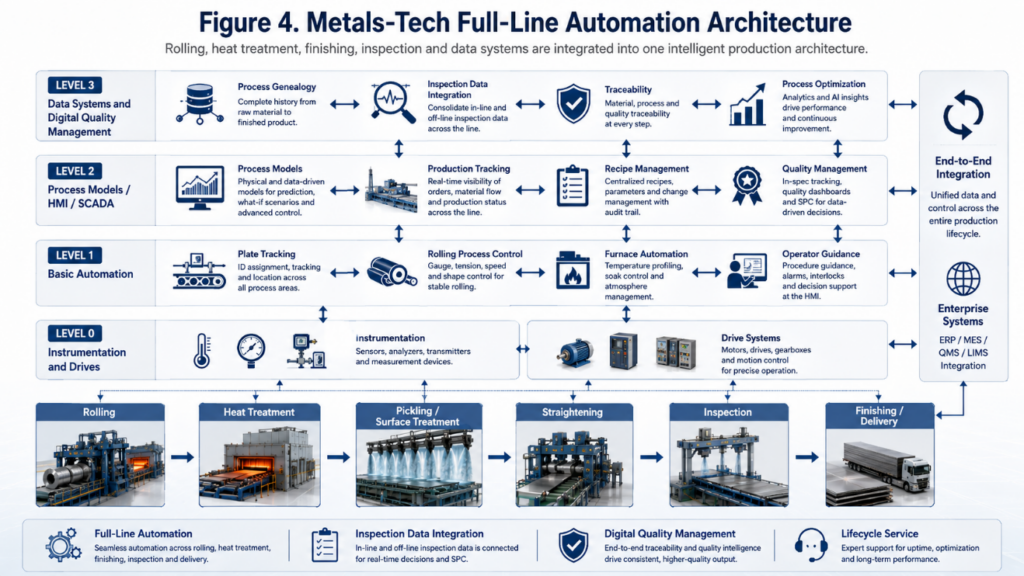
| Metals-Tech Solution | Application Value |
| Full-line automation | Coordinates rolling, heat treatment, pickling, straightening and inspection |
| Plate tracking system | Ensures material identity across the complete process |
| Rolling process control | Improves thickness, shape and rolling stability |
| Furnace automation | Supports precise heat treatment and recipe execution |
| Inspection data integration | Links quality results with production history |
| Digital quality management | Creates traceable process and product records |
| Process optimization | Supports stable production of complex grades |
| Lifecycle service | Helps producers improve performance after commissioning |
Through these solutions, Metals-Tech helps customers move from equipment operation to process intelligence.
High-End Materials Need High-End Control
The future of stainless steel and special alloy plate will not be decided by capacity alone. It will be decided by the ability to manufacture difficult products consistently.
For duplex stainless steel, super duplex stainless steel, super austenitic stainless steel, nickel-based corrosion-resistant alloys, high-temperature alloys and precipitation-hardening stainless steels, every process step matters. Melting quality, reheating, rolling, heat treatment, finishing, inspection and traceability must work together.
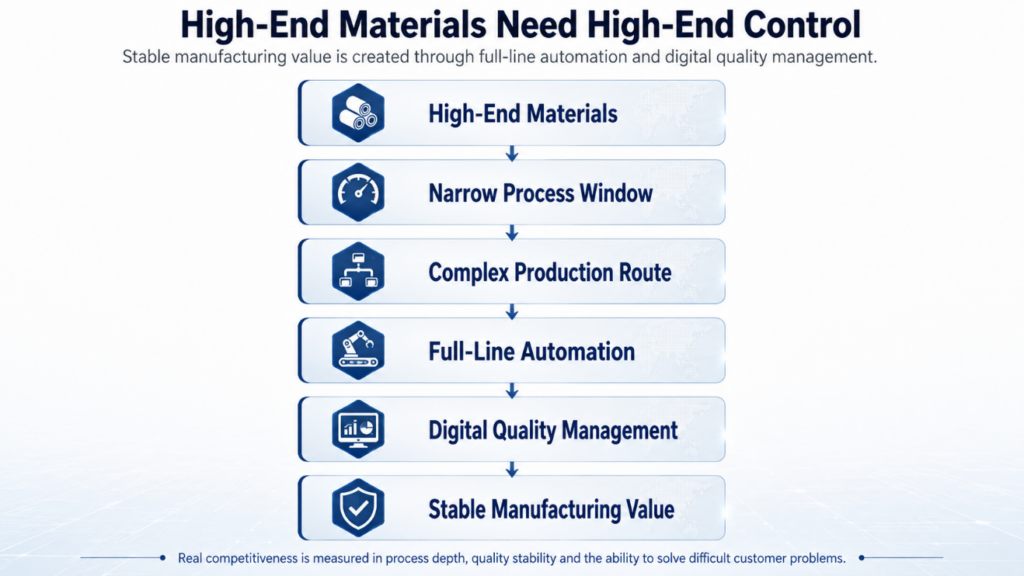
This is the core direction of the modern special alloy plate industry.
Conclusion: The Next Stage Is Not Bigger, but Deeper
The stainless steel industry has already built enough capacity. The next stage of competition will not be defined only by who can produce more, but by who can produce better, faster and more reliably for demanding applications.
High-end stainless steel and superalloy plate production requires a deeper form of capability: metallurgical understanding, flexible production organization, precise automation, robust heat treatment, reliable inspection and digital process traceability.
Metals-Tech is committed to supporting this transformation.
By providing full-line automation and full-process quality management solutions, Metals-Tech enables plate producers to build stable, repeatable and high-value manufacturing capability for the most demanding materials.
In the future, the strongest producers may not be those who say, “We can make everything.”
They will be those who can clearly define their strongest grades, their strongest specifications and the industries they serve best.
For high-end stainless steel and superalloy plate, real competitiveness is not only measured in tons. It is measured in process depth, quality stability and the ability to solve difficult customer problems.


